
SAPS Police Trainee Recruitment 2026/2027: Which Tattoos Are Allowed and Which Could Disqualify You?
Can You Join SAPS If You Have Tattoos?
Thousands of South Africans are applying for the South African Police Service (SAPS) Police Trainee Recruitment Programme for 2026/2027. However, one recruitment requirement has raised an important question among applicants: Can someone with tattoos still qualify to become a SAPS police officer?
The answer is yes, potentially. Having a tattoo does not automatically disqualify every applicant. However, the location, visibility and content of the tattoo are important considerations during recruitment.
For the 2026/2027 Police Trainee intake, the official SAPS eRecruitment advertisement states that applicants must not have tattoo marks that will be visible when wearing any SAPS uniform.
SAPS eRecruitment Portal
This means that an applicant with a tattoo on a part of the body normally covered by the prescribed police uniform may still meet the tattoo visibility requirement.
However, applicants should understand that a hidden tattoo is not automatically guaranteed to be acceptable. SAPS also has regulations concerning tattoos that conflict with the objectives of the police service.
What Does the Official SAPS Tattoo Policy Say?
The official 2026/2027 recruitment advertisement includes the following requirement:
“Not have any tattoo marks which will be visible when wearing any uniform of the Service.”
This requirement is important because SAPS has different types of uniforms, and a tattoo that is covered by ordinary clothing might not necessarily be concealed by every prescribed police uniform.
The South African Police Service also clarified its position in a written parliamentary response published in 2022.
According to that response, the tattoo requirements have two important components:
- Tattoos must not be visible when an officer wears the SAPS uniform.
- Even tattoos that are covered by the uniform must not be incompatible with the objectives of the Service.
These requirements were explained with reference to Regulation 11 of the Regulations for the South African Police, 1964.
parliament.gov.za
Therefore, applicants should consider both where their tattoo is located and what the tattoo represents.
Which Tattoos May Be Accepted by SAPS?
SAPS does not publish an official list guaranteeing acceptance of particular tattoo designs or body locations for the 2026/2027 trainee intake.
However, the recruitment requirements suggest that certain tattoos may be compatible with the rules, provided they remain fully concealed by every applicable police uniform and do not conflict with SAPS objectives.
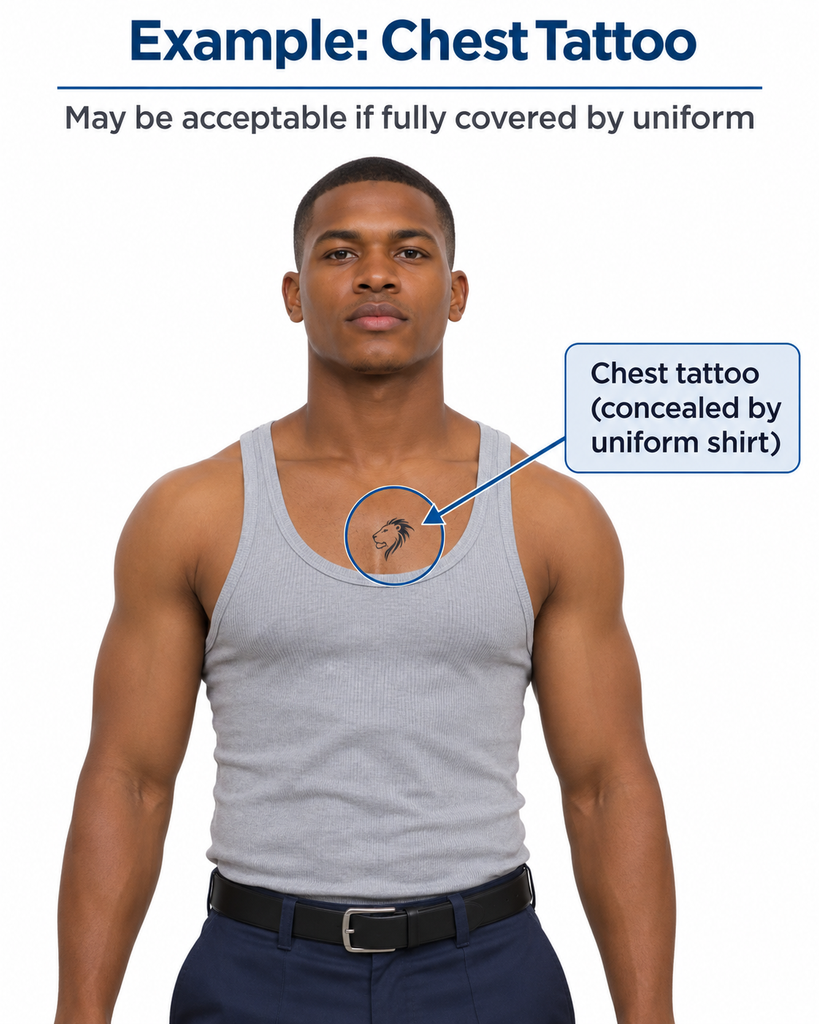
1. Tattoos on the Chest
A tattoo on the chest may be acceptable if it is completely covered by all prescribed SAPS uniforms.
For example, an applicant with a small name, date or decorative tattoo on the chest might satisfy the visibility requirement.
However, if the tattoo extends above the uniform neckline and becomes visible, it could result in disqualification.
2. Tattoos on the Back
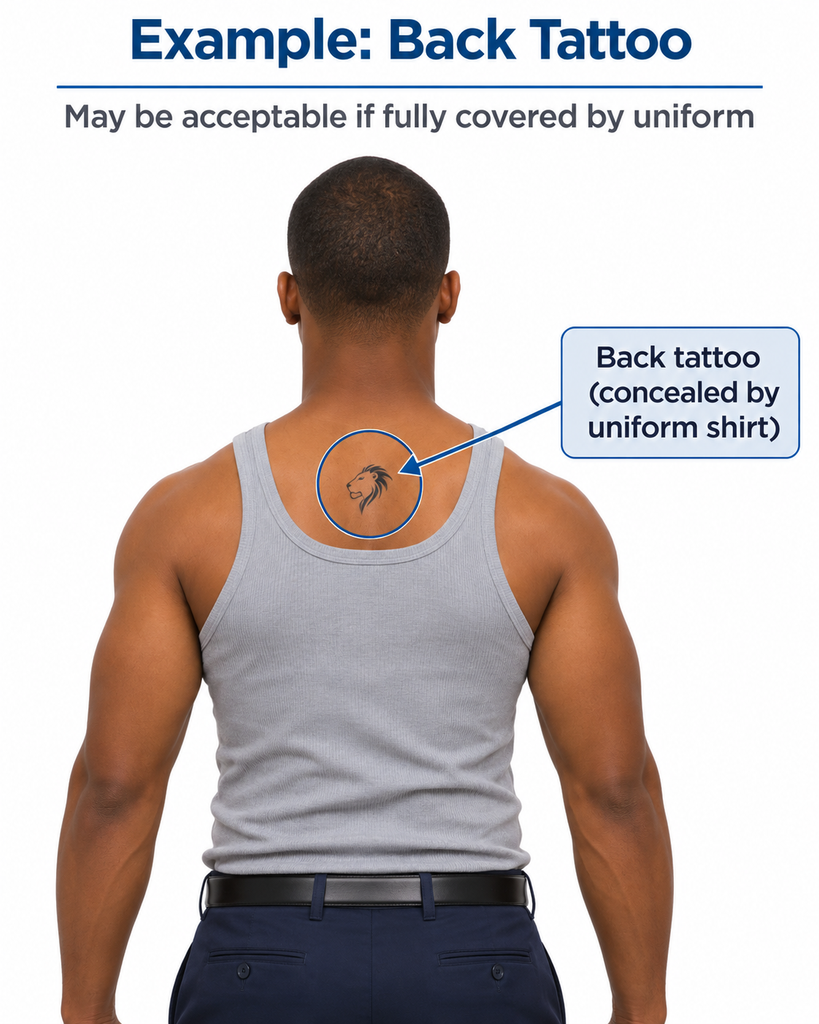
Back tattoos may also satisfy the visibility requirement when they remain fully covered by the uniform.
An applicant with a tattoo on the upper or lower back should consider whether any part of the design could become visible near the collar or another uniform opening.
The content of the tattoo must also be considered, regardless of whether it is hidden.
3. Tattoos on the Upper Arms
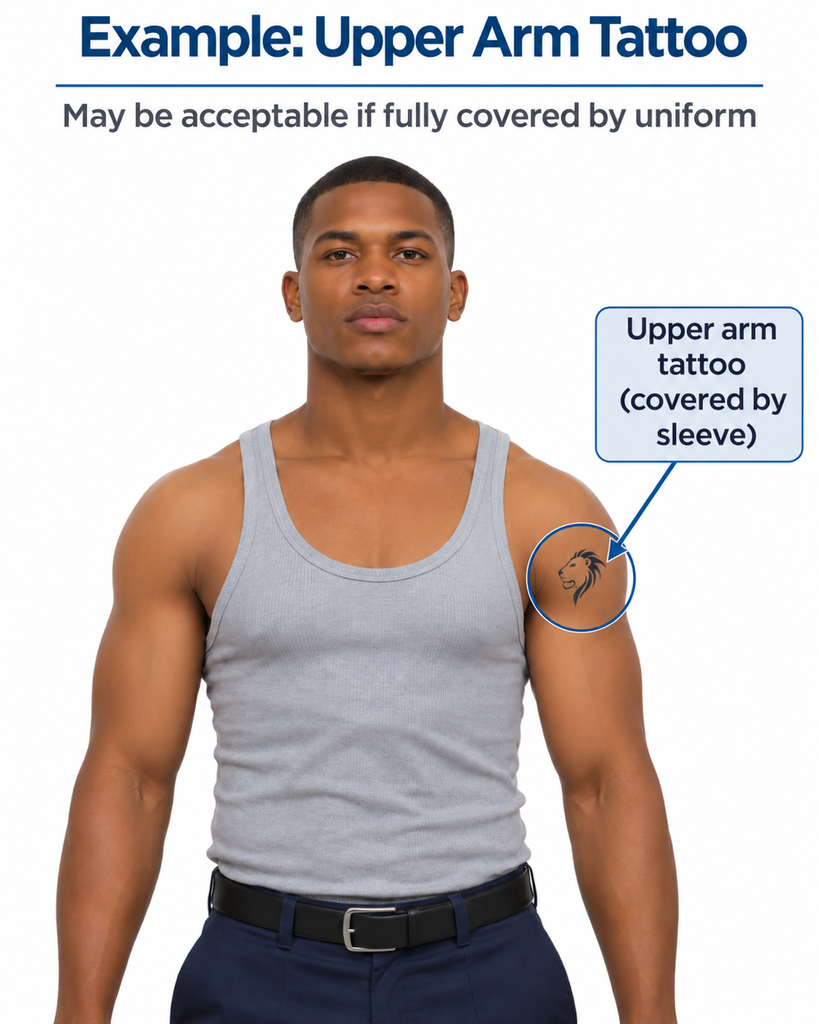
Upper-arm tattoos require additional attention.
A tattoo positioned high on the upper arm may be concealed by some uniforms but could be exposed by shorter sleeves.
Applicants should not assume that a tattoo is permitted simply because it is hidden when wearing a long-sleeved shirt.
The important consideration is whether the tattoo remains concealed when wearing any applicable SAPS uniform.
4. Tattoos on the Thighs
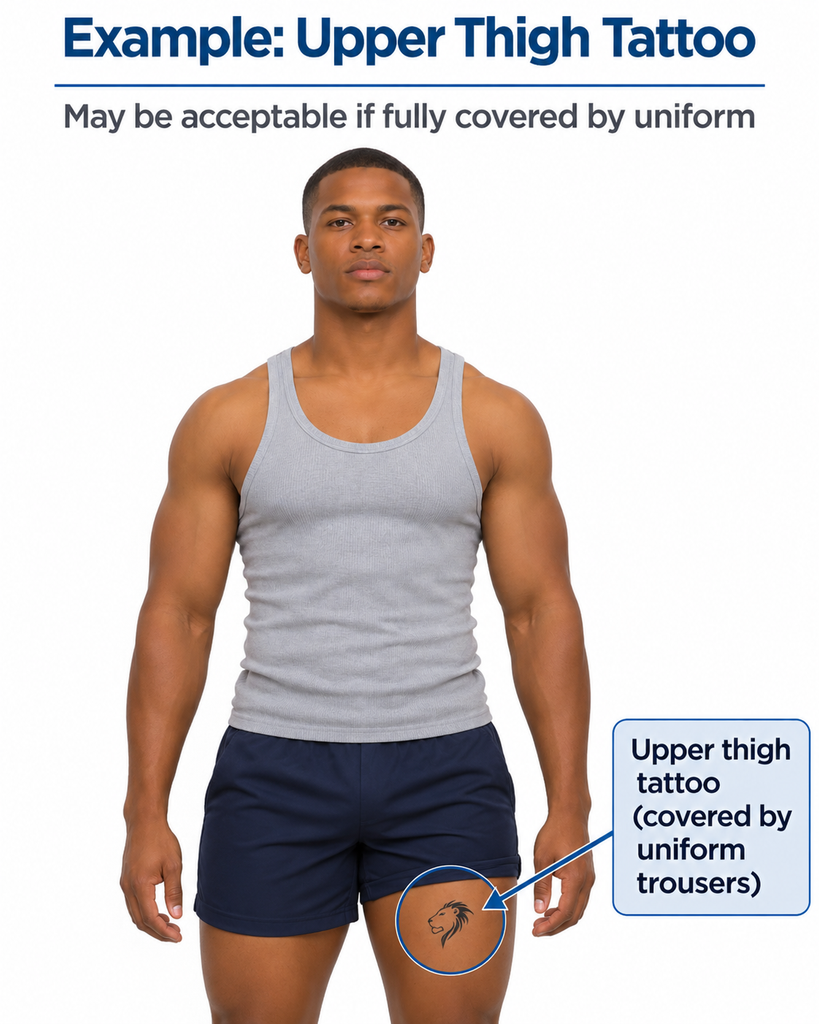
A tattoo on the upper thigh may meet the visibility requirement if it remains completely hidden by the prescribed uniforms.
However, applicants should not treat thigh placement as an automatic exemption from the tattoo rules.
The final assessment depends on the applicable uniform requirements and the tattoo itself.
5. Tattoos on the Stomach or Ribs
Tattoos on the stomach, abdomen and rib area may also satisfy the visibility requirement if they are concealed by the uniform.
A small personal tattoo in one of these areas is not necessarily disqualifying.
Nevertheless, SAPS may consider the tattoo’s content and whether it is compatible with the organisation’s objectives.
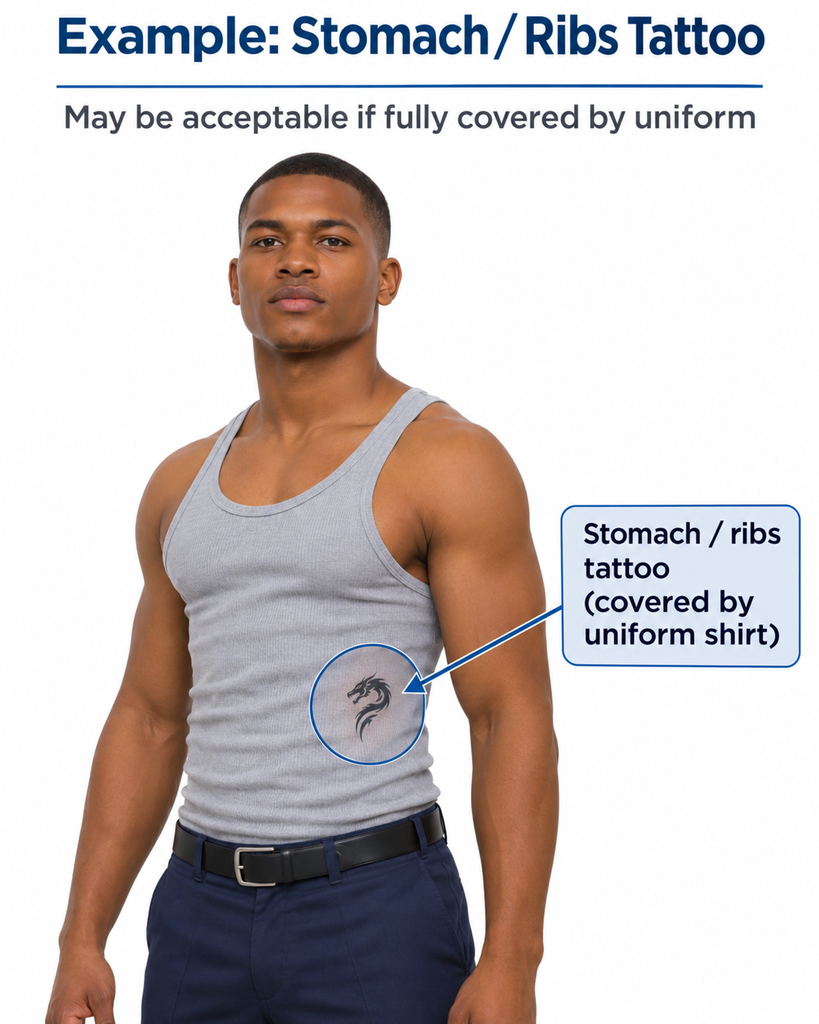
Important: These examples describe tattoos that may meet the published requirements. They are not an official SAPS-approved list, and only the relevant SAPS recruitment process can determine whether an individual applicant complies.
Which Tattoos Could Disqualify Applicants?
Certain tattoos present a much greater risk of disqualification because they are commonly visible while wearing police uniforms.
| Tattoo location | Recruitment implications |
|---|---|
| Face | Normally visible; likely disqualifying |
| Neck | Usually visible; high risk of disqualification |
| Hands and fingers | Usually visible; high risk of disqualification |
| Wrists | May remain exposed; high risk |
| Forearms | Often visible with short sleeves |
| Upper arms | Depends on coverage by every applicable uniform |
| Chest and back | Potentially acceptable if fully concealed |
| Stomach and ribs | Potentially acceptable if fully concealed |
| Thighs | Potentially acceptable if fully concealed |
| Ankles and lower legs | Depends on visibility in applicable uniforms |
This table is an interpretation of the published visibility requirement, not a separate official SAPS classification of body locations.
For example, an applicant with a tattoo on their forearm should not assume that wearing a long-sleeved uniform will solve the problem. The 2026/2027 recruitment condition refers to any uniform of the Service, rather than only one uniform chosen by the applicant.
Similarly, covering a tattoo with a watch, plaster, makeup or accessory should not be treated as proof that the applicant meets the requirement. The official recruitment advertisement does not establish such an exemption.
Can a Hidden Tattoo Still Disqualify Someone?
Yes, potentially.
The parliamentary explanation of SAPS tattoo regulations makes it clear that the content of a tattoo can be relevant even when the tattoo is not visible while wearing a uniform.
Tattoos associated with criminal organisations, intimidation, hateful ideologies or other imagery fundamentally incompatible with the duties and objectives of policing could raise serious concerns.
For example, a tattoo that openly promotes criminal violence or racial hatred could be assessed as incompatible with the Service’s objectives, regardless of its location.
However, SAPS has not provided a comprehensive public catalogue of prohibited tattoo symbols in the 2026/2027 trainee advertisement. Applicants should therefore avoid assuming that every tattoo within a particular artistic or cultural category is automatically prohibited.
The relevant concern is whether the tattoo conflicts with SAPS requirements, not simply whether another person dislikes the design.
Frequently Asked Questions About SAPS Tattoos
Can I join SAPS with a tattoo on my hand?
A hand tattoo is likely to disqualify an applicant because hands are normally exposed when wearing a police uniform.
The official recruitment advertisement does not provide a general exception for small hand tattoos, names, initials or symbols.
Can I join SAPS with a tattoo on my neck?
A visible neck tattoo would ordinarily fail the recruitment requirement.
Even a small tattoo behind the ear or near the neckline could be problematic if it is visible while wearing any prescribed SAPS uniform.
Can SAPS accept a tattoo of my child’s name?
Possibly, provided the tattoo is completely concealed by the prescribed uniforms and its content does not conflict with SAPS objectives.
The fact that a tattoo represents a child’s name does not create a special exemption from the visibility requirement.
Are religious tattoos allowed in SAPS?
Religious tattoos are not automatically accepted or rejected based solely on their religious meaning.
The published requirements do not establish a blanket exemption for religious tattoos. Visibility and compatibility with SAPS objectives remain relevant, and any specific legal or accommodation questions would require individual consideration.
Can I join SAPS with a tattoo on my leg?
It depends on the tattoo’s exact position and whether it would be exposed by any applicable SAPS uniform.
A tattoo on the upper thigh may remain concealed, while a tattoo extending toward the ankle could present a greater visibility risk.
Applicants should not assume that all leg tattoos are permitted.
Will SAPS accept a tattoo if I cover it with makeup?
The published 2026/2027 advertisement does not provide an exemption allowing applicants to conceal otherwise visible tattoos with makeup.
Applicants should therefore not rely on makeup as a way to satisfy the requirement.
Can I apply if I have already started removing my tattoo?
The advertisement does not provide a special exception for applicants who are undergoing tattoo removal.
If the tattoo remains visible when wearing a prescribed uniform, there may still be a problem.
Applicants considering removal should understand that professional tattoo removal generally requires multiple sessions and may not eliminate every visible trace.
Does having a tattoo automatically mean I will fail the SAPS recruitment process?
No.
The official requirements do not impose a blanket prohibition on every tattoo, regardless of location.
An applicant with a concealed tattoo may still qualify, provided the tattoo complies with the relevant requirements and the applicant meets all other recruitment conditions.
What Should Applicants With Tattoos Do Before Applying?
Applicants should carefully review the tattoo requirements before submitting an application.
They should establish whether any part of their tattoo would be visible when wearing the prescribed SAPS uniforms, including uniforms with shorter sleeves.
Applicants should also consider the tattoo’s design and meaning, particularly where it could be associated with criminal activity or conduct incompatible with police service.
Where there is uncertainty, applicants should seek clarification directly from SAPS recruitment officials rather than relying on social media rumours.
Applicants should also answer all tattoo-related questions truthfully during recruitment. Failure to provide accurate information could create additional concerns during the assessment process.
SAPS Police Trainee Recruitment 2026/2027 Details
| Recruitment information | Details |
|---|---|
| Employer | South African Police Service |
| Programme | Police Trainee 2026/2027 |
| Reference number | TRA26/27 |
| Positions | 5,500 |
| Qualification | Grade 12 or equivalent |
| Age requirement | 18–35 years |
| Training stipend | R5,000 per month |
| Closing date | 13 November 2026 |
| Application method | Online SAPS eRecruitment portal |
The official SAPS vacancy confirms the reference number, monthly stipend and principal recruitment requirements.
SAPS eRecruitment Portal
Applications must be submitted through the official SAPS recruitment system.
Official application link: SAPS eRecruitment Portal
Applicants can also read the full recruitment advertisement using the official SAPS Police Trainee vacancy page.
Closing Date: 13 November 2026
As of 2 November 2026, prospective applicants have 11 calendar days remaining before the published closing date.
Applicants are encouraged to verify that they meet the requirements before submitting their applications. SAPS recruitment is free, and applicants should avoid individuals who request payment in exchange for recruitment assistance or guaranteed selection.
Conclusion: Which Tattoos Will SAPS Accept in 2026?
The most important point for applicants to understand is that SAPS does not automatically reject every person who has a tattoo.
Instead, the 2026/2027 recruitment requirements focus on whether the tattoo is visible when wearing any SAPS uniform. Existing SAPS regulations also address whether the content of a tattoo conflicts with the objectives of the Service.
Tattoos located on the chest, stomach, ribs, back or upper thighs may satisfy the visibility requirement if they remain completely concealed. However, their location alone does not guarantee acceptance.
Visible tattoos on the hands, neck, face, wrists or forearms present a greater risk of disqualification.
Ultimately, applicants should avoid assuming that a particular tattoo is permitted without considering the official requirements.
For verified recruitment information, prospective applicants should consult SAPS directly.